First Home · Charlotte

How Much House Can I Afford in Charlotte, NC? (2026)

How much house can you afford in Charlotte, NC? The honest math: why pre-approval is not your budget, the full monthly picture, and the cash you need.
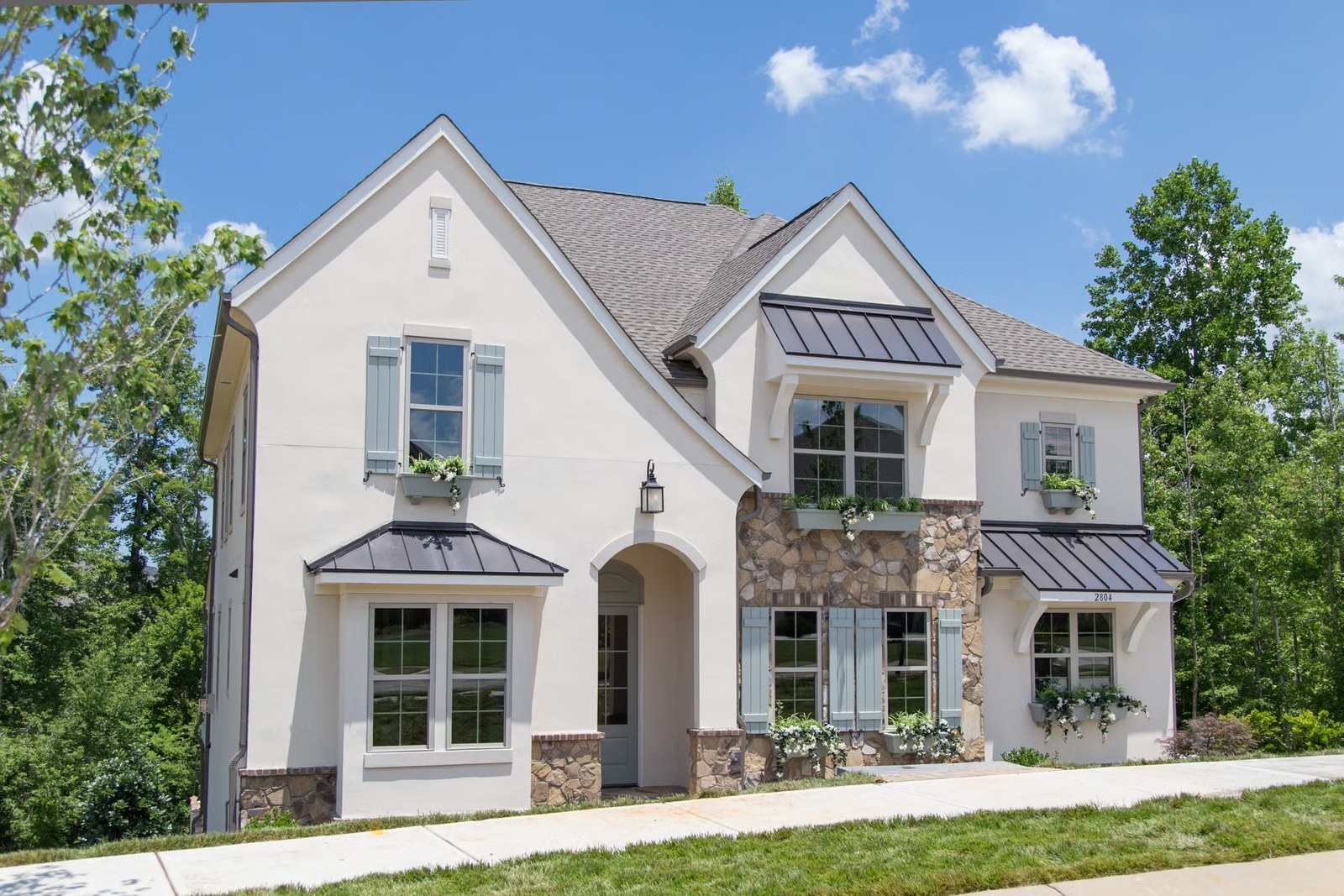
A cream stucco home with stone accents and an arched entry
The short answer

What you can afford in Charlotte isn't the number on your pre-approval letter — that's your ceiling, not your target. Your real number is the monthly payment that still leaves room to live: mortgage plus NC property taxes, insurance, and HOA dues, with margin for maintenance and an actual life. Build from monthly comfort backward, not from the loan maximum down.

How much house can you afford in Charlotte?

Every buyer I work with in Charlotte eventually meets two numbers. The first arrives on a pre-approval letter, and it's almost always bigger than expected. The second never gets written down anywhere official — it's the payment you could make every month without holding your breath. The entire art of affording a home well is knowing that these are different numbers, and choosing the second one on purpose.

A lender's job is to tell you the most they're willing to lend based on your income, debts, and credit. It's an honest answer to a question you didn't ask. The question you actually care about — what can I carry comfortably while still living my life? — is one only you can answer, and it deserves more rigor than the approval did. So let's do that math properly, the way I'd do it with you at a kitchen table.

Why is the pre-approval number not your real budget?

Pre-approval formulas look at your gross income and your debt payments. They do not know that you want to keep traveling, that you're building a business on the side, that a child or a career change is on the horizon, or that you'd rather fund your retirement than your foyer. They also assume a version of you that never has a bad quarter.

Buy at the top of the ceiling and the house is technically yours — but so is the tightness. Every month becomes a small negotiation between the mortgage and everything else. I've watched buyers in beautiful homes live with a low hum of financial stress that no amount of natural light fixes. The homes that actually feel like sanctuary are almost never the maximum ones. They're the ones with margin built in.

Here's the reframe I'd offer: the pre-approval tells you where the wall is. You don't build your life against the wall.

What is the full monthly cost of owning a home in Charlotte?

The number that breaks people is almost never the mortgage. It is the fourth or fifth line underneath it — the one that shows up in month three, after the budget was built and already spent, and quietly turns a payment you were proud of into a payment you are managing.

When people search "how much house can I afford," they're usually picturing principal and interest. In Charlotte, the real monthly number has more moving parts, and they're worth understanding before you fall for anything:

  1. Property taxes. North Carolina property taxes are moderate compared to the Northeast, but they're real, they vary by county and municipality across the Charlotte area, and revaluations can move them. They ride along in your monthly payment through escrow — budget for them as a permanent tenant.
  2. Homeowners insurance. Premiums have risen across the country in recent years, and Charlotte is no exception. Get an actual quote on a home you're serious about rather than assuming a rounded guess.
  3. HOA dues. Much of Charlotte's newer housing — townhomes, master-planned communities, many condo buildings — comes with monthly or annual HOA dues. Sometimes modest, sometimes a meaningful line item, and they tend to rise over time. A home that fits your budget without dues may not fit with them.
  4. Maintenance. Not a bill, but a certainty. Older homes in Charlotte's established neighborhoods carry more of it; new builds carry less at first but not forever. A sensible cushion here is the difference between an inconvenience and a crisis.

The honest affordability question is: what does the whole monthly picture look like — and does it still leave room for the life I moved here to live? None of these four is a surprise to anyone who already owns a home. They are only a surprise to people who budgeted from the mortgage figure — and that surprise always arrives the same way, which is late, in a month you had planned to spend on something else. You can meet these numbers now, on a spreadsheet, while they are abstract. Or you can meet them one at a time, on their schedule instead of yours. If you're weighing the broader picture, my cost of living in Charlotte guide walks through what everyday life here actually costs.

How much cash do you need up front in North Carolina?

North Carolina does contracts differently than most states, and this catches relocating buyers off guard constantly. When your offer is accepted here, you typically pay the seller a due diligence fee — a negotiated amount that buys you a window to inspect, appraise, and investigate the home. Here's the part that matters: it's non-refundable. If you walk away during due diligence, even for a good reason, that money generally stays with the seller.

In competitive Charlotte segments, due diligence fees can be substantial — real cash, out of pocket, before you own anything, and separate from your down payment and closing costs. This changes the affordability math in two ways. First, your "cash to buy" is more than your down payment. Second, it raises the cost of choosing wrong — which is exactly why I'd rather see you tour fewer homes with a clear budget than make aggressive offers on maybes.

None of this is a reason for alarm. It's a reason for a plan. Buyers who understand the due diligence system before they offer use it calmly; buyers who learn about it mid-offer make expensive, rushed decisions.

Do interest rates and buydowns change what you can afford?

As of mid-2026, rates have been sitting in the mid-sixes — meaningfully higher than the era everyone still remembers, and meaningfully calmer than the headlines suggest. Two things are worth knowing.

First, rate buydowns exist: you (or sometimes a seller or builder, as a negotiated concession) pay money upfront to lower your interest rate, either permanently or for the first year or two. On new construction especially, builder-paid buydowns are a common incentive. A buydown can genuinely help — or it can be a shiny distraction from an inflated price. The math depends on how long you'll hold the loan and what the upfront cost is, and it's worth running with a lender you trust rather than accepting from a sales office.

Second, and more importantly: don't build your budget on a rate you hope to have someday. "I'll stretch now and refinance later" is a bet, not a plan. Buy a payment you can genuinely carry at today's rate. If rates fall and you refinance, that becomes a bonus — margin, not rescue.


A pale lavender Charlotte office wall with a desk and lamp
The pre-approval is a ceiling. Your number lives well under it.

How do you find your real number?

Work backward, not forward:

  1. Start with your monthly life. Look at what you actually spend and save now, and decide what total housing cost — mortgage, taxes, insurance, dues, a maintenance cushion — leaves that life intact. Not survivable. Intact.
  2. Pressure-test it. Would that payment still feel fine in a slower year? With one more kid, one job change, one big repair? If the answer requires optimism, lower the number.
  3. Then get pre-approved — and treat the letter as your ceiling, with your comfort number as the actual budget. The gap between them is your margin, and margin is what makes a house feel like an exhale instead of a held breath.
  4. Add your cash-to-buy reality: down payment, closing costs, due diligence fee, and reserves left over after closing. A home that empties every account isn't affordable, whatever the letter says.

What you qualify for and what feels like an exhale each month are two different questions. Only one of them determines how you'll feel walking through your front door on an ordinary Tuesday in year three.

What should you do once you know your number?

A number by itself will not protect you. I have watched buyers do this work honestly, land on a figure they trusted, and spend past it anyway — because the first house that genuinely moved them was eleven thousand dollars above the line, and eleven thousand dollars sounds like nothing when you are standing in a kitchen you already love.

So write the number down before you tour, and say it out loud to someone. Not because you are weak about money — because you are about to spend weekends in rooms designed to make a number feel abstract, and a figure you have said to another person is much harder to quietly move.

Your affordability number is one coordinate. The other is what that number buys in Charlotte — and that varies more by area and lifestyle than most people expect. If you're earlier in the process, what $700K buys across four Charlotte lifestyles makes that concrete, and if this is your first purchase, my first-home guide walks the whole decision at the same calm pace.

And if you want to skip straight to orientation: take the Move Quiz. Two minutes, and it maps where you are — budget, timeline, and what you're actually solving for — so the next conversation starts from your real situation instead of a generic one.

Take the Move Quiz →

A number on its own does not buy anything. Here is what to look for in an agent before you set a budget.

How much house can you afford on a $100,000 salary?

This is the version people actually type, and it is usually typed late at night, after a day of looking at houses that felt just out of reach. What they want is not a calculator. They want to know whether the gap they are sensing is real, or whether they are doing something wrong that everyone else has figured out. It is real, it is arithmetic, and it is knowable — so it deserves a real answer rather than a calculator link.

Start with the shape of the arithmetic, because the shape is stable even when the numbers move. A $100,000 gross salary is about $8,333 a month before tax. Underwriting does not look at what is left after your life; it looks at the ratio of your total monthly debt to that gross figure. Many conventional files are comfortable when total debt sits somewhere around a third of gross income, and some programs stretch further with strong reserves or credit. Take a third of $8,333 and you are near $2,750 a month for everything — the mortgage, the taxes, the insurance, any mortgage insurance, any association dues, plus the car payment and the student loan you already have.

Now watch what that does. If you carry a $500 car payment, your housing number is not $2,750, it is closer to $2,250 — and that single line moves your price range by tens of thousands of dollars. This is why two households on identical salaries get very different answers, and why paying off one small loan before you apply is often worth more than waiting for rates to shift.

The part Charlotte adds is the back half of that payment. Principal and interest are only part of it. Property taxes here are levied per hundred dollars of assessed value by the county and, inside the city, by the city as well, and they are reassessed on a cycle rather than annually. Insurance has moved. An association fee, where there is one, is a fixed monthly number that eats the same budget as the mortgage. A rate quote alone will not tell you any of this.

So the honest method is three steps, and you can run it this week. Ask a lender for the debt-to-income ratio they are actually using on your file, not the general guideline. Ask for a payment breakdown on a real property in your range, with the actual tax bill and the actual dues, not an estimate. Then decide what monthly number you would still be comfortable paying in a year when something goes wrong. That last number is the one that belongs to you, and it is almost always below the first two. Run those three steps and the figure stops being something the market decides about you and becomes something you decided. Skip them and you do not avoid the arithmetic — you meet it later, at a closing table, as a fact rather than a choice.

Sources

  1. Consumer Financial Protection Bureau — how much can you afford, and understanding loan estimates
  2. Fannie Mae Selling Guide — debt-to-income ratios and qualifying income
  3. North Carolina Association of REALTORS® / NC Bar Association — Offer to Purchase and Contract (Form 2-T)
  4. North Carolina Department of Insurance — homeowners insurance rate information

Described generally and current as of publication; figures and programs change. Eridania M. Bonilla is a licensed North Carolina broker (NC 359549) with Better Homes and Gardens Real Estate Paracle; each office is independently owned and operated. Equal Housing Opportunity. Not lending, tax or legal advice.

Sixty seconds, no pressure

Which territory are you in?

The Move Quiz maps where you actually are — timeline, budget band, and what you are solving for — in about a minute.

Take the Move Quiz →

Frequently asked

How much house can I afford in Charlotte on my income?

More useful than an income multiple: build backward from the total monthly payment — mortgage, NC property taxes, insurance, and any HOA dues — that leaves your savings and lifestyle intact, then confirm a lender will approve it. Your pre-approval is your ceiling; your comfort number is your budget.

What costs surprise Charlotte buyers most?

The North Carolina due diligence fee — a non-refundable payment to the seller when your offer is accepted, separate from your down payment and closing costs. HOA dues in newer communities and rising insurance premiums are the other two that most often go unbudgeted.

Should I buy at the top of my pre-approval?

Almost never. The pre-approval reflects the most a lender will risk, not what your life can comfortably carry. Homes bought at the ceiling leave no margin for maintenance, change, or simply living — and margin is what makes a home feel calm instead of tight.

Is a rate buydown worth it in Charlotte?

Sometimes — especially builder-paid buydowns on new construction, which cost you nothing directly. Run the actual math with a lender: how much upfront, how long you'll hold the loan, and whether the incentive is masking a price you shouldn't pay. Never stretch your budget assuming a future refinance.

What debt-to-income ratio do lenders want in North Carolina?

Lenders look at your total monthly debt against gross income, and the acceptable ratio varies by loan program and by the strength of the rest of your file. Ask your lender for the ratio they are using and what it would take to improve it — the number is a policy, not a law.

What salary do you need to buy a $400,000 house?

There is no single figure, because the answer moves with your rate, your other debts, the property's tax bill and any association dues. The way to get your own number is to work backwards: ask your lender what total monthly payment your file supports, then have them price that payment against a real Charlotte property including taxes and insurance rather than a generic estimate.

A cream dining wall with soft directional light
Two numbers exist. Only one of them is yours.
Eridania M. Bonilla, REALTOR®
Your guide
Eridania M. Bonilla
REALTOR® · Better Homes and Gardens Real Estate Paracle

I help Charlotte families buy, move up, and relocate without losing their footing — treating the whole thing as one calm decision instead of a pressured scramble. Twenty-five years in brand and design before real estate taught me that how a place feels is the whole point.

Atención completa en español — escríbeme con confianza.

The quiet letter

One thoughtful note a month

Neighborhood reads, market truth, and the occasional exhale. No noise — unsubscribe anytime.